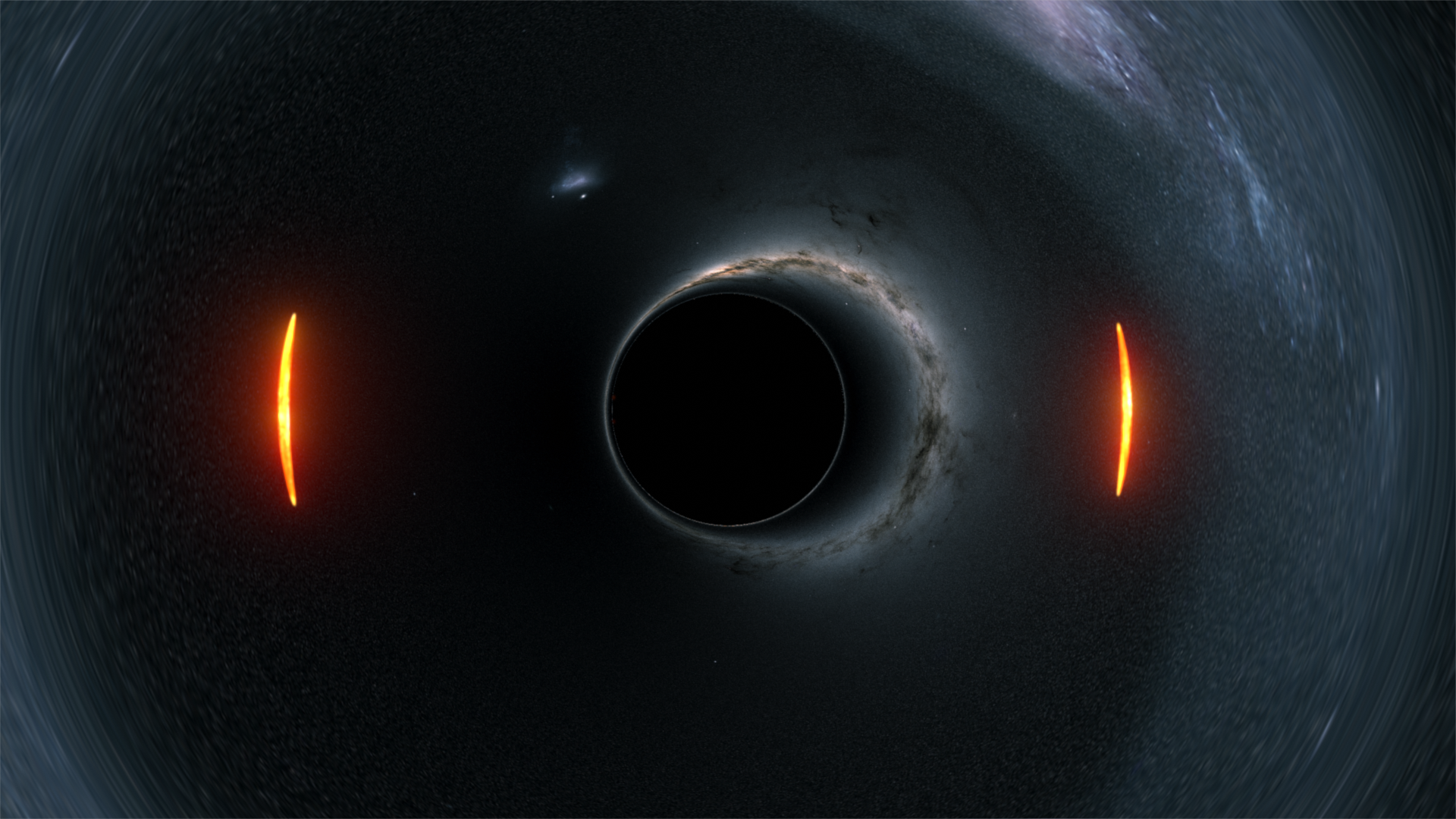
Our nearest black hole, Gaia BH1. Image Credit: Thomas Müller, HdA/MPIA
Hunting for Dark Companions
According to population models, we expect around 10 billion stellar mass black holes to exist in the Milky Way - however, to this day, detections of these objects are very rare. My work aims to search for stellar mass, dormant black holes in close, detached binaries, using a variety of possible signatures. These include, but are not limited to, ellipsoidal variation and doppler beaning of the light curve of the stellar companion, red- and blueshift variations in the star's spectrum, and light-centroid wobble of the companion’s position on the night sky. To this end, photometric, spectroscopic and astrometric data is used. I have contributed to some of these searches, particularly through the use of my disentangling code to rule out a potential luminous companion. See Gaia Black Hole 1 and Gaia Black Hole 2 for more details.